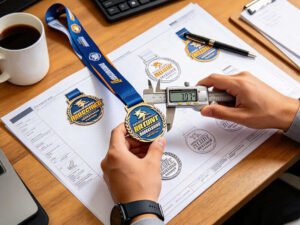
Think about the moment a runner finishes a race and smiles for the official camera. What catches your eye first? It is almost never the small lettering stamped into the medal. Instead, it is the bright fabric strap framing the runner’s face and draping over their shoulders. In finish-line photography, the neck ribbon commands visual attention long before anyone reads the medal. Yet many race organizers treat the ribbon as a forgotten afterthought, picking a plain stock band at the very last minute. This textile deep dive complements the hardware blueprints found in カスタムレースメダルの究極ガイド, ensuring ribbons and medallions balance in harmony.
Popular running publications like Runner’s World frequently note that race medals are the quintessential swag that runners show off across social media. Pairing a heavy metal award with a cheap, scratchy ribbon ruins the entire experience. It feels like serving a gourmet meal on a paper plate. Conversely, a wide, silky, full-color dye-sublimated ribbon can elevate even an inexpensive stock medal into an award that feels luxurious. More importantly, smart ribbon design gives you space to display sponsor logos, organize multi-distance events, and save your budget by making medals reusable. This guide explains how to design custom ribbons that enhance your awards, delight your runners, and protect your bottom line.
目次
Master Ribbon Comparison: Fabrics, Printing, and Costs
When selecting medal ribbons, race directors face a choice between three primary production styles: plain solid stock, screen-printed webbing, and full-color dye-sublimation. While stock ribbons appear cheap at first glance, they offer zero branding value. Screen printing adds simple text, but the rubbery ink can crack and peel. Dye-sublimation remains the gold standard for endurance races because it infuses vibrant colors deep into the fabric weave.
Review the comparison table below to examine how these ribbon styles perform across comfort, graphic detail, durability, and commercial value.
| Ribbon Manufacturing Style | Base Fabric Material | 色 & Graphic Capability | Tactile Comfort on Skin | 耐久性 & 寿命 | Relative Sourcing Cost |
|---|---|---|---|---|---|
| Plain Stock Grosgrain | Ribbed woven polyester | Single solid color or simple stripes | Stiff, rough ribbed texture; can chafe | Durable, but zero custom branding | Lowest ($0.40 to $0.50 each) |
| Screen-Printed Webbing | Flat woven polyester | 1 to 2 solid spot colors; no gradients | Raised, rubbery ink ridges felt on neck | Ink can crack or flake over time | Moderate ($0.80 to $1.10 each) |
| Full Dye-Sublimation | Ultra-dense silky polyester | Unlimited colors, photos, and gradients | Completely smooth, silky, skin-friendly | Permanent; will not fade, peel, or wash out | Best value ($1.00 to $1.40 or free in bulk) |
| Recycled rPET Eco-Ribbon | Recycled post-consumer plastic | Full-color dye-sublimation printing | Soft, smooth, identical to virgin poly | Highly durable and sustainable | Slight premium ($1.30 to $1.75 each) |
The differences are not just visual. When an athlete runs thirteen or twenty-six miles, their neck is hot and covered in sweat. A stiff, scratchy ribbon rubs against sensitive skin and causes irritation. A smooth, silky sublimated ribbon feels like cool satin, turning the finish-line award into a moment of pure comfort.
The Science of Dye-Sublimation: Why Heat-Transfer Beats Screen Printing
To understand why dye-sublimation looks so striking, you have to look at the chemistry of how color attaches to fabric. Traditional screen printing pushes thick liquid ink through a mesh stencil onto the surface of a woven strap. That ink sits like a rubbery layer on top of the threads. Over time, sunlight, sweat, and bending cause screen-printed ink to crack, peel off, and feel rough against the skin.
Dye-sublimation takes an entirely different scientific approach. Specialized digital printers first print your custom artwork onto coated transfer paper using disperse dye inks. The paper and plain white polyester ribbon are then fed together through heavy steel rollers heated to 200 degrees Celsius under intense pressure. At that extreme temperature, something extraordinary happens: the solid ink turns directly into a gas without melting into a liquid.
The high heat also causes the synthetic polyester fibers to expand, opening tiny molecular pores. The gaseous dye penetrates deep inside the open fibers. When the ribbon exits the heated rollers and cools, the polyester pores snap shut, trapping the color permanently inside the thread. The color is not resting on the surface. It is physically part of the fabric itself.
This process offers race directors major advantages:
- Zero Surface Texture: Because the ink lives inside the fibers, the ribbon remains completely soft and silky to the touch.
- Unmatched Detail: Digital print heads reproduce photographic sunrise backgrounds, subtle color transitions, and delicate sponsor logos with razor-sharp precision.
- Permanent Colorfastness: Sublimated ribbons can be soaked in sweat, rained on during coastal storms, or washed in home laundry machines without fading, bleeding, or flaking.
Sizing, Widths, and Proportions: The Visual Balance Rule
A medal and its ribbon work as a single visual unit. If you pair a massive four-inch die-cast zinc medallion with a narrow 0.75-inch ribbon, the combination looks awkward and unbalanced. Even worse, narrow ribbons act like thin cords under heavy weights. They dig into the back of an athlete’s neck and twist around constantly, causing the medal to flip backwards during photos.
The standard adult neck ribbon measures between 32 and 36 inches in total loop length. This length allows the medal to hang comfortably across the center of the runner’s chest, right above the race bib number. When selecting the width, follow the visual balance rule:
| Medal Outer Diameter | Typical Metal Weight | Recommended Ribbon Width | Visual and Practical Benefit |
|---|---|---|---|
| 1.75 to 2.25 Inches | 40 to 60 grams | 1.0 Inch (25 mm) | Lightweight, ideal for youth runs and casual 5Ks |
| 2.50 to 3.00 Inches | 60 to 80 grams | 1.25 to 1.50 Inches | Standard road-race balance; keeps medal facing forward |
| 3.00 to 3.75 Inches | 80 to 110 grams | 1.50 Inches (38 mm) | The marathon benchmark; spreads weight comfortably across neck |
| 4.00 Inches and Larger | 120 to 180+ grams | 1.75 to 2.00 Inches | Maximum luxury; prevents heavy zinc medals from pulling or roping |
A 1.5-inch (38 mm) ribbon has become the gold standard for competitive road races and marathons. This width provides plenty of surface area to display your race name in bold, legible typography while giving corporate sponsor logos the breathing room they need to be recognized.
The Reusability Masterstroke: Date-Free Metal, Dated Ribbon
One of the most painful moments in race management is tossing hundreds of leftover medals into scrap bins after race weekend. If severe thunderstorms or extreme heat keep runners at home, an organizer can easily end up with surplus awards. If your metal mold is stamped with a permanent date like October 14, 2026, those medals cannot be handed out next season. They become instant, expensive waste.
Experienced race organizers avoid this trap by using a modular date system. Keep your metal casting completely timeless. Feature your race name, logo, distance, and city landmarks on the front of the medal, but leave the year off the metal mold entirely.
Instead, print the specific year, calendar date, and edition number on the custom dye-sublimated neckband:
- Metal Medallions Cost $2.00 to $4.00+: Reordering custom metal medals requires minimum order thresholds and new mold fees.
- Sublimated Ribbons Cost Less Than $1.00: Fabric ribbons can be ordered in small quantities with fast turnaround times.
If bad weather leaves you with one hundred extra medals at the finish line, you simply unclip the ribbons, pack the metal medallions into clean storage boxes, and order fresh ribbons next season. You save your organization hundreds of dollars, eliminate scrap waste, and reuse your original steel casting mold for three to five consecutive years without paying a single penny in new tooling charges.
Monetizing Ribbon Real Estate: Solving the Cluttered Medal Face
Every race director needs sponsors to help cover operating expenses. In exchange, sponsors want their logos seen by participants. However, trying to squeeze six or eight corporate partner marks onto a three-inch metal medal creates an aesthetic disaster. The logos must be shrunk down until they are illegible, raised metal borders become clogged with paint, and the central course artwork gets ruined.
The neck ribbon provides the ultimate solution. A 36-inch ribbon provides over one hundred square inches of continuous, flat graphic space. By moving sponsor marks to the fabric strap, you keep the medal face clean and artistic while giving your partners prominent visibility.
Follow the repeating pattern layout along the ribbon strap:
The Professional Repeating Pattern: Race Title Sponsor → Official Event Name → Course Distance → Secondary Corporate Partner → Event Slogan → Charity Beneficiary.
Major international events, like the famous road races organized by the New York Road Runners, understand that the finish-line photograph is the most shared image of race weekend. When an athlete smiles for a snapshot holding their medal, the ribbon hangs along both sides of their chest. Sponsor logos appear right beside the runner’s face. You can package this exclusive ribbon placement as a high-tier sponsorship asset, easily generating two to five thousand dollars in sponsorship revenue that completely pays for your medal order.
Some premier events, such as the Miami Marathon, take this artistry even further by commissioning recognized local artists to design their annual ribbon patterns. The ribbon becomes an authentic piece of wearable cultural art that runners cherish just as much as the metal itself.
Multi-Distance Tiering: Organizing 5K, 10K, and Half Marathons
Operating a race weekend with several divisions—such as a 5K, 10K, and half-marathon—presents a major logistical challenge. If you order three completely different metal medals, you have to pay for three separate steel casting molds. On top of that, finish-line volunteers in crowded exit chutes can easily get confused, accidentally handing an expensive half-marathon medal to a 5K fun runner.
Using a single master medal mold with customized ribbon colorways solves both problems at once. You pay for just one steel mold tooling fee. Then, you order your dye-sublimated ribbons in three distinct, high-contrast color combinations:
| イベント部門 | Master Metal Medal Finish | Primary Ribbon Colorway | Printed Ribbon Typography | Finish Chute Visual Clarity |
|---|---|---|---|---|
| Half-Marathon (13.1 Miles) | Antique Silver Zinc Alloy | Deep Royal Blue | Bold Metallic Gold Lettering | Instantly recognizable from 20 feet away |
| 10K Road Competition | Antique Silver Zinc Alloy | Bright Crimson Red | Crisp Clean White Typography | High contrast; clear separation |
| 5K Community Run/Walk | Antique Silver Zinc Alloy | Vibrant Emerald Green | High-Visibility Yellow Lettering | Distinct family and casual division marker |
| キッズ’ Fun Dash | Antique Silver Zinc Alloy | Multi-Color Rainbow | Playful White Block Text | Exciting visual appeal for youth runners |
When runners enter the finish chutes, volunteers do not have to squint at small metal engravings. They look at the bright ribbon color and instantly hand out the correct award. Your chute moves smoothly without bottlenecks, and your event saves hundreds of dollars in setup costs.
Attachment Hardware and Finish-Line Ergonomics
How a ribbon connects to a metal medallion affects how the award hangs against the runner’s body. There are three common attachment methods used in medal production, and each serves a specific purpose:
- The Sewn V-Neck Loop: This is the standard choice for road races and marathons. The ribbon is folded at a 45-degree angle, threaded through the medal’s top loop, and secured with heavy-duty box or bar-tack stitching. This creates a natural neck contour, ensuring the medal hangs perfectly flat against the runner’s chest without flipping backwards.
- The Metal Jump Ring: A classic open steel wire ring connects the medal loop to the ribbon. While inexpensive and easy to assemble, jump rings allow medals to spin freely, often causing awards to turn sideways during finish-line photos.
- The Swivel Lobster Clasp: Essential for functional medals like bottle openers, coasters, or belt buckles. A spring-loaded metal clasp allows runners to detach the fabric ribbon in one second so they can use the medal as a tool without wrestling with a three-foot strap.
Always verify the stitching quality with your supplier. A heavy die-cast marathon medal weighs between 80 and 120 grams. If a factory uses weak nylon thread or single-line stitching, the sudden weight of dropping the medal around a runner’s neck can snap the seam. Reputable factories perform tensile pull tests to guarantee that stitching withstands at least twenty pounds of force, ensuring your awards never hit the asphalt.
Sustainability and Weather Defense: Eco-Fibers and Dye Bleed Prevention
Environmental responsibility is an increasing priority for running communities. Discarded plastic water bottles and single-use event supplies create heavy landfill waste. Race directors can make a powerful environmental statement by choosing sustainable ribbon materials:
- Recycled Polyester (rPET): Made from melted, post-consumer recycled plastic bottles. rPET ribbons look, feel, and perform identically to virgin polyester. They offer the exact same silky hand-feel, high tensile strength, and full-color sublimation capabilities while keeping plastic out of oceans.
- Natural Bamboo and Organic Cotton: These plant-based fibers offer an earthy, textured, matte appearance that pairs wonderfully with wooden medals and backcountry trail ultramarathons.
- Plantable Seed-Paper Ribbons: Innovative biodegradable ribbons embedded with dormant wildflower seeds. After the event, runners can plant the ribbon in their home garden and watch native flowers bloom, leaving a living memory of their achievement.
Equally critical is weather defense. Picture this nightmare: an athlete runs twenty miles in heavy rain, crosses the finish line, and puts on their favorite white running jacket. An hour later, cheap chemical dyes from a wet medal ribbon have soaked through, staining their expensive jacket with permanent dark red streaks.
This disaster happens when factories use cheap dyes that fail colorfastness testing. High-grade suppliers test all sublimated ribbons under wet-rub friction standards. The heat-press process must fully vaporize and lock the disperse dyes into the polyester core so that sweat, torrential rain, and humidity can never cause dyes to migrate onto clothing or stored metal surfaces.
Frequently Asked Questions About Custom Medal Ribbons
1. Will custom dye-sublimated ribbons fade or bleed when runners sweat?
No. Dye-sublimation converts disperse dyes into gas that permanently bonds inside the polyester fibers. Because the color becomes part of the thread rather than sitting on top, sublimated ribbons will not bleed, run, or fade when exposed to heavy sweat, rain, or machine washing.
2. Can you print sponsor logos on both sides of a medal ribbon?
Yes. Full-color dye-sublimation supports dual-sided printing. Many organizers feature their race name, distance, and primary logo along the outer facing strap, while dedicating the inside strap to a repeating pattern of corporate sponsor logos.
3. What is the standard ribbon width for a half-marathon or marathon medal?
A width of 1.5 inches (38 mm) is the recognized standard for half-marathons and marathons. This width comfortably distributes the weight of a heavy 3.0 to 3.5-inch metal medal across the neck while providing ample room for legible logos in finish-line photographs.
4. How does putting the year on the ribbon save money?
Leaving specific years and dates off the metal casting mold allows you to reuse surplus medals for future events. By printing the date exclusively on the neck ribbon, any leftover metal medallions can be reused next season simply by ordering inexpensive replacement ribbons.
5. Are ribbons shipped already attached to the medals?
With reputable suppliers, standard custom orders include full ribbon assembly. Ribbons are sewn, clipped, and assembled onto the medals at the factory, saving your organization hundreds of volunteer hours on race week.
6. What is the difference between a sewn loop and a jump ring attachment?
A sewn loop folds the ribbon at a clean 45-degree angle and stitches it directly to the medal loop, ensuring the medal hangs flat against the chest. A jump ring uses an open wire circle that allows the medal to turn, which can cause awards to flip sideways during photos.
7. Can ribbon colors be matched to exact corporate brand colors?
Yes. Digital sublimation printers are calibrated using the Pantone Matching System (PMS Solid Coated). By providing specific PMS codes, race directors ensure that sponsor logos and race brand colors match perfectly across ribbons, race shirts, and banners.
8. What are eco-friendly medal ribbons made from?
Sustainable ribbons are typically woven from recycled polyester (rPET) made from post-consumer plastic water bottles. Organizers can also choose organic cotton, bamboo fibers, or biodegradable seed paper embedded with dormant wildflower seeds.
Transforming Your Race Awards from the Neck Down
Every finisher medal represents countless miles of discipline, early mornings, and personal perseverance. When runners cross that finish line, the neck ribbon is the very first thing that touches their skin and frames their victory smile. By giving the ribbon the creative attention it deserves, you transform a standard piece of hardware into a cherished, comfortable keepsake that athletes wear with immense pride.
Smart ribbon design is also a powerful business strategy. Moving sponsor logos to the fabric strap keeps your medal face artistic while unlocking high-tier sponsorship revenue. Using distinct ribbon colors allows you to organize multi-distance festivals with a single casting mold. And keeping calendar dates on the ribbon rather than the metal preserves your budget, letting you reuse surplus inventory season after season.
If you are planning your upcoming race calendar and want experienced guidance on dye-sublimation graphics, ribbon widths, or hardware attachments, our team at 格安ラペルピン工場 is here to help. We provide expert design advice, free digital design proofs, and reliable manufacturing to ensure your race medals and ribbons look extraordinary on race day.
Ready to Elevate Your Race Medals with Custom Ribbons?
Share your race branding, sponsor logos, and distance lineup with us today. Our design team will create a complimentary digital proof and an all-inclusive quote to make your race awards truly unforgettable.